
 18/09/2026
Members of the Moldova State University (MSU) community – faculty staff, researchers, and students –…
 28/08/2026
On September 9, 2026, 14:00-15:30 CEST, an online meeting “Transparency as a Driver of Equity:…
 23/07/2026
Following on from 2024’s record 8.4 billion national and international authentications, eduroam has reached new…
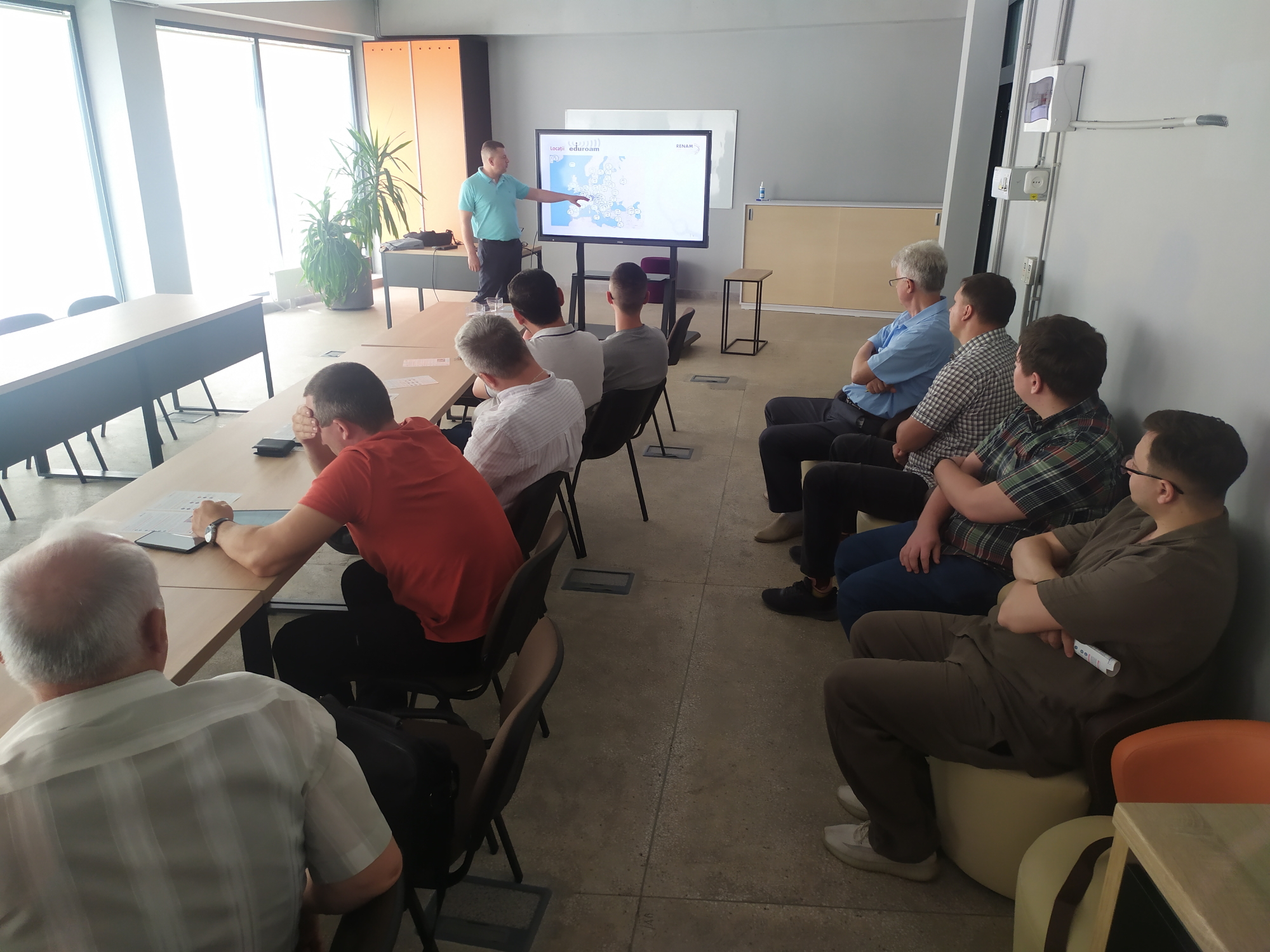 On June 22, 2026, RENAM delivered a seminar for the promotion of services in support of the research and education community in Moldova, the event was hosted by the Nortek Innovation and Technology Transfer Center of the Alecu Russo State University of Bălți (USARB). As the national research and education network, RENAM develops modern electronic communications infrastructure and provides high-speed internet access and advanced digital services to academic institutions across the country.
In his introductory presentation, Anatol Goncearuc, Executive Director at RENAM, spoke about the stages of the RENAM network’s creation, the importance of RENAM’s access to the GÉANT pan-European academic network, the international projects implemented to develop regional infrastructure, the investments attracted, and their impact (in particular, facilitating the participation of scientists, students, and academics in global R&E collaborations; deploying services that facilitate international collaboration and stimulating integration with GÉANT and other European e-infrastructure services; building knowledge, skills and community through workshops, training, mentorships, conferences and other initiatives).
RENAM specialists Alexandru Cacean, Valentin Pocotilenco and Olga Popcova gave presentations on a variety of digital services, emphasizing the value of secure, federated access.
eduroam – the secure, world-wide Wi-Fi roaming access service developed for the international research and education community. It allows students, researchers and staff from participating institutions to obtain Internet connectivity across campus and when visiting other participating institutions by simply opening their laptop, mobile phone or other device.
eduroam users from Moldova can also freely access the internet abroad – with more than 10,000 eduroam hotspots across more than 100 countries – whether they are participating in the Erasmus+ international exchange programme, a scientific conference or a collaboration.
eduVPN – a secure network connection service to access internal resources of the institution as well as services from different or remote locations.
eduGAIN – a user authentication and authorisation service within the national identity federation LEAF (MoLdovan ResEarch and EducAtion Identity Federation), which simplifies access to national and European information resources for the research and education community. Today eduGAIN is used by over 80 national federations worldwide connecting more than 8,000 Identity and Service Providers. Several examples of resources were outlined in this regard:
FileSender – a service that enables to send large files quickly and securely. The sender has full control over who receives and can access the files and for which period of time – as it should be. With privacy, data security and digital sovereignty high on the agenda of both organizations and individuals, the FileSender open source web-application provides a secure, trustworthy and transparent way for sharing large files. According to the FileSender deployment map updated in April 2026, there are 54 countries in the world where the FileSender service is provided to the corresponding national R&E communities. In the Republic of Moldova the FileSender service is implemented by RENAM to support research and education institutions: https://filesender.renam.md/
EOSC EU Node services – a robust set of 6 services, that in its goal to accelerate the adoption of Open Science, address key challenges in modern research workflows, allowing users to operate efficiently within data-intensive environments:
An updated EOSC EU Node User Access Policy (version 2.3.4) defines the access groups, their corresponding access rights, service limits, and virtual credit allocation policies for the users. It brings clearer user roles, increased credit allocations, and expanded access to compute services, ensuring that the EOSC EU Node platform keeps pace with the needs of Europe’s research community. In particular, the policy outlines the following roles:
Credits are virtual, they have no monetary value. Credits are replenished to the default allocation every three months (90 days) period.
17 representatives of the USARB attended the seminar. The discussion that followed the presentations covered a variety of areas, such as the usefulness of the presented services, organizational issues and benefits of access through eduGAIN to various resources, eduroam coverage in Moldova and abroad, technical aspects of the FileSender service, etc.